
LEARNING FOR DEVELOPMENT


Practical Steps for Surfing the Wave of Technology-Mediated Learning


Papua New Guinea Association for Distance Education (PNGADE)

Biennial Conference
9-10 April 2008 - Port Moresby

Open and Distance Learning for Access to Education and Development

Practical Steps for Surfing the Wave of Technology-Mediated Learning
 

by
Sir
John Daniel
Commonwealth
of Learning


Introduction

It is a great pleasure to be back in Papua New Guinea . I was last in your wonderfully rich and diverse country two years ago for the launch conference of the Papua New Guinea Association for Distance Education. I believe that meeting marked a turning point for the development of distance education and technology-mediated learning in PNG.

I met Dame Carol Kidu for the first time during that visit. At the conference dinner she made a passionate speech about the role of distance education in community development. All who were there can still recall her inspiring words.

I am delighted to tell you that the Secretary-General of the Commonwealth has recently appointed Dame Carol to be a member of the Board of Governors of the Commonwealth of Learning representing the Pacific Region. We are delighted by her appointment, which I am sure will lead to more intense COL activity in the Pacific Region in general and in PNG in particular. I welcome her to the COL community. I am aware that she has followed COL closely for some years through our newsletter Connections and knows us well.

The launch conference of PNGADE and my meeting with Dame Carol also marked the beginning of a notable increase in the activities of the Commonwealth of Learning in your country. In inviting me to speak to you today you asked me to talk about what COL is doing in PNG and also about the role of ICTs in enhancing education, training, and learning generally.

I shall speak to that brief and the title of my remarks today is Practical Steps for Surfing the Wave of Technology-Mediated Learning. COL is a very practical and pragmatic organization. We believe that what counts is what works. But at the same time when a technology-based approach works we like to reflect on why it works and describe it as a model. This is essential if we are to transfer an approach from one country to another. Are the essential elements of the model present? If not can they be obtained?

I thought at first of addressing these two topics sequentially - first COL's work in PNG and then the role of ICTs - but I'd decided to address them together because that will help to root my comments ICTs in reality.


Development as Freedom

When I was here at your 2006 conference I talked to you about Learning for Development: The Role of Distance Education. I discussed with you what we mean by this word 'development' defining it, with Amartya Sen, as freedom. I talked about the various freedoms that entailed and I shall not repeat that here. I went on to discuss how we express the grand ideal of development as freedom in concrete terms so that we can work towards it. COL brings together three groups of objectives and values for this purpose.

First, there are a number of Millennium Development Goals and COL is focused on some of these. They were articulated in 2000 and the target date for achieving them is 2015, so more than half the time has run out. Next are the six goals of Education for All, formulated at a World Forum in Dakar , also in 2000. Finally there are the key Commonwealth value of peace, equality, democracy and good governance. COL brings these three sets of goals together as a framework for our programme of action. This defines our overall purpose: Learning for Development.

We divide the work that we do to achieve that purpose into three sectors: Education, which centres on supporting and advancing the formal education system; Learning for Livelihoods, which focuses on equipping people with skills to earn a better living; and Human Environment, which brings together learning activities that can improve the quality of life through better health, a cleaner environment, and so on.


Outcomes sought

In carrying out activities within each of these sectors we aim for one or more of four outcomes.

First, twenty years' experience at COL has taught us that the use of technology to enhance learning will be more successful, more effective and more sustainable if a framework of policy is put in place first. This may mean a national policy for the use of ICTs in schools, for instance. Or it could mean policies at the institutional level, such as a policy to guide a university that wishes to operate in dual mode; that is to say to teach both on campus and through distance learning. We did that here last year when we responded to a request from the Higher Education Commission to advise on the institutional structures for distance learning.

Second, much of our work is concerned with helping people become more skilled at operating technology-based learning systems. As you know, these have an operational dynamic that is different from classroom teaching and people need training for that. A good example is COL 's work in helping countries to become more effective in running open and alternative systems for secondary schooling based on a combination of distance learning and local centres. Here in PNG we are helping with capacity building in FODE.

Third, as I already noted, we always try to distil our experience of successful applications of technology in support of learning for development into models. A good example that I shall describe more fully in a minute is our Lifelong Learning for Farmers programme. We developed this in India , where it is undoubtedly helping to make villages more prosperous. Today we are working with colleagues in PNG to see whether it could help to increase rural prosperity here. We need to know why it works in India in order to apply it intelligently here. What are the necessary ingredients for success?

Finally, although COL does not develop learning materials directly, we help others to do so. A relevant example for PNG is the Commonwealth Executive Master of Business Administration programme, CEMBA, and its partner the Commonwealth Executive Master of Public Administration programme, CEMPA. The CEMBA/CEMPA programmes were developed by the four open universities of south Asia, in Bangladesh, India, Pakistan and Sri Lanka . It is now being adopted here by UPNG.


COL's Programme

So what does all this mean in concrete terms? What does COL actually do with its partner countries and institutions? In each of the three sectors we have five initiatives.

In the Education sector these are: Quality Assurance for education, training and learning at all levels; Teacher Development, meaning scaling up and improving teacher education both pre- and in-service; open or alternative schooling, as I just mentioned; higher education; and eLearning for education sector development.

In the Learning for Livelihoods sector the five initiatives are: Learning and Skills for Livelihoods; Rural and Peri-Urban Community Development, which is where the Lifelong Learning for Farmers programme fits; National and International Community Development, which means working with national and international bodies to promote technology-mediated learning; the Virtual University for Small States of the Commonwealth, with which PNG is strongly engaged; and Transnational Programmes, which refers to programmes like CEMBA/CEMPA, which are offered in various countries around the world.

Finally in the sector for Human Environment, which is our least developed sector at present, we work to promote Gender and Development; Health, Welfare and Community Development; Environmental Education; Good Governance; and the Educational use of Mass Media and ICTs.

That, if you like is our Commonwealth-wide menu. But not every country wants to try every dish, and we could not cope if they did, so we discuss with each Member State which of these 15 initiatives match its own priorities.

From these discussions we developed country action proposals, and after the Commonwealth Ministers of Education had approved our overall plan at their triennial conference in Cape Town, South Africa in 2006, we translated these proposals into Country Action Plans. So the Country Action Plan for Papua New Guinea indicates which of the 15 dishes on the menu PNG wants to have, and how it wants it cooked; in other words what is the specific activity within each chosen initiative that it wants to develop with COL.

So what I shall do now is to go through the items that appear in the Country Action Plan for PNG, pausing longer on particular initiatives to show how they are helping your country take practical steps to surf the wave of technology-mediated learning, in the words of my title.


Education

So, to start with the Education Sector, PNG intends to work with COL in all five areas, although since we are only half way through the three-year plan for 2006-09, some are more developed than others.

Quality Assurance

In the area of Quality Assurance PNG can benefit from a Toolkit called Quality Assurance for Teacher Education and Development. This was produced by a team of specialists from across the Commonwealth and includes Quality Indicators for Teacher Education and Best Practices in Teacher Education. I launched this Toolkit at a conference in Bangalore, India , last December and copies are being made available around the Commonwealth.

Teacher Development

In the vital area of Teacher Development COL has helped PNG in a more specific way by carrying out a review of the Teacher Education Programme at the Open College of UPNG. This report was also completed and handed over last December. I hope that it will be useful in charting a way forward.

Open/Alternative Schooling

Open and alternative schooling is one of COL 's most important initiatives at the moment. We feel it has great potential for PNG, and FODE is showing the way. The Millennium Development Goal for Education focuses on the achievement of Universal Primary Education by 2015 and a huge international effort has been deployed for this purpose. And it is bearing fruit, although some countries may still miss the 2015 target.

But the steady increase in the numbers completing primary education is sending a surge - some call it a tidal wave - of youngsters in search of secondary schooling. The countries that are struggling to achieve Universal Primary Education simply do not have the resources to build secondary schools on the scale required.

Open schooling, which combines distance learning materials with support in local centres, sometimes including support through ICTs, has great potential. Last year COL did a thorough evaluation of open schooling in India and Namibia . For an equivalent result open school costs less then 10% of the cost of conventional schooling in India and around 20% in Namibia. This is a very significant difference.

We hope that more and more countries will explore the possibilities of surfing the wave of technology-mediated learning in the area of open schooling. It could give tens of millions of youngsters access to secondary schooling. Given your complicated geography this is a very important opportunity for PNG, and COL looks forward to working with you on it.

Higher Education

In the area of higher education I have already mentioned the adoption by UPNG of the CEMBA/CEMPA programme. This was developed in south Asia but is now spreading around the Commonwealth; to UPNG here in the Pacific, to the Caribbean, and to south-east Asia.

COL has also responded to a request from the Higher Education Commission for advice on the organisation of open and distance learning at tertiary level in PNG. The work was done by one of Canada's leading experts, Professor Dominique Abrioux, former president of Athabasca University . He has great expertise in the two ways of organising ODL: first as a stand-alone open university; second as one of the two modes of teaching of a dual-mode institution that operates both on campus and at a distance.

eLearning for Education Sector Development

Finally in the Education sector, COL is working with PNG to develop skills in eLearning, which is a very important development for distance education even when courses cannot be delivered directly to students electronically because of lack of connectivity.

That is because familiarity with eLearning is the key to developing Open Educational Resources. These are bits of learning material - big or small - that you can pull down from the world-wide web and adapt to your own use. This is very important, since no resource from elsewhere is likely to be exactly what you want.

Once you have done the adaptation, which is very easy when the resource is held electronically, you can, of course, turn it into other formats such as print. Last week in the state of Maharashtra in India I launched a major project for the creation of open educational resources at the school level. Many of them were on display as printed materials since these are more useful to the schools of Maharashtra than material that can only be accessed through the Internet.

COL is helping colleagues in PNG develop skills in eLearning in several ways.  

First, one way of creating Open Educational Resources, or OERs, is by using a Wiki. A Wiki is a website on which any user can edit and update pages.  The best known is the Wikipedia, the biggest encyclopaedia ever produced.  COL has created WikiEducator, which creates online communities whose members participate from remote locations to create educational content collaboratively and to plan conferences and other events.  COL 's WikiEducator is reaching 70% of the countries in the world. It has grown rapidly during the past year with the number of registered users passing the 2600 mark and number of hits per day now exceeding 70,000.

Working with the New Zealand Ministry of Education, COL hosted a Pacific regional OER workshop on last year. Mr. Demas Tongogo of FODE was among representatives of nine jurisdictions who took part. This event established a firm foundation for future collaborations in eLearning for the region and also launched a Pacific chapter called "WikiPacifica" and began planning for national and regional activities for developing OERs.

I am pleased to say that the William and Flora Hewlett Foundation, which has been the great supporter of the OER movement, has given COL a grant of $US100,000 to support workshops on OERs in every country of the Commonwealth. The first was held in the Solomon Islands last year and one will be held here later this year.


Learning for Livelihoods

I turn now to our second sector of activity: Learning for Livelihoods.

Virtual University for Small States of the Commonwealth

Since it follows on logically from my comments about OERs and WikiEducator let me start with the Virtual University for Small States of the Commonwealth. PNG is fully engaged with this initiative, which emerged some years ago from the Education Ministers of the small states who decided that they would join together to conquer and assimilate the eWorld.

The name that they chose, the Virtual University for Small States of the Commonwealth or VUSSC, is somewhat misleading because it is not a new institution but a product of the participating countries and their existing tertiary institutions. It is a collective mechanism for producing, adapting and deploying courses and learning materials, on selected subjects selected by ministers of education.  It also provides a special opportunity for their people to develop expertise in online collaboration, eLearning and ICTs generally. 

The model that has developed is a three-week training and course development workshop at which subject specialists from a subset of the participating states strengthen their IT skills and begin to develop course material collaboratively online.

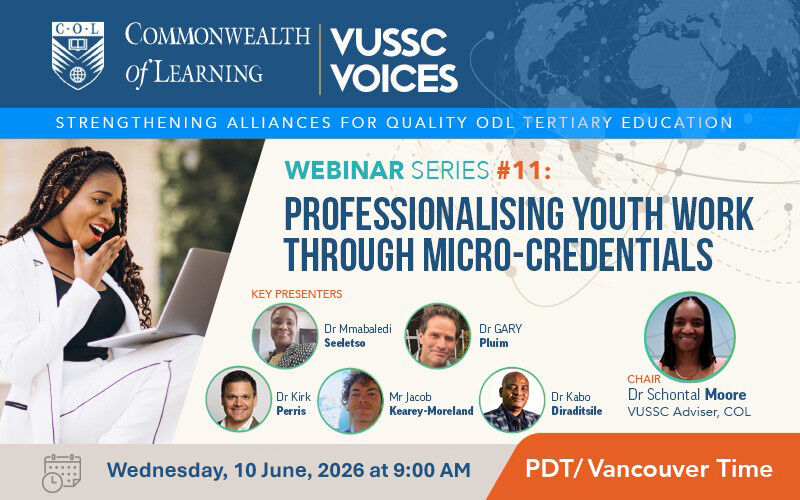
The first training workshop was hosted by Mauritius in August 2006 to develop programmes on entrepreneurship, tourism and hospitality. The second was held in Singapore in March 2007 on the professional development of educators and Ms. Lydia Lute Hiawalyer of UNPG took part. Similarly Ms. Elizabeth Kendrun of the National Department of Health participated in the 3rd workshop in Trinidad & Tobago on Life Skills in June 2007. In November 2007 there was a workshop in Samoa on disaster management where PNG was represented by Ms. Eileen Turare of UNPG. Finally, Mr. Saun Ignatius Biat of NARI Livestock Programme took part in the 5th workshop in Seychelles , which was on the fishing industry. I am delighted by this high level of participation by PNG because the VUSSC is a major vehicle for engaging with the eWorld.

Prisca Move of PNG took part in meeting of senior officials from participating VUSSC countries held in Singapore in February 2008 to consider, refine and agree mechanisms of a transnational qualifications framework, the first of its kind to be attempted.  The South African Qualifications Authority (SAQA), an organisation with wide experience of establishing frameworks in South and Southern Africa, helped to prepare a concept document and facilitate the proceedings. PNG submitted information on its National Qualifications Framework for analysis at that meeting. 

If you rank the various tertiary institutions of the small states of the Commonwealth by the level of their participation in VUSSC meetings UPNG comes out in 8th place, which is good, because these are just the top participants. I hope that while I am in PNG I can get feedback from your participants in these workshops. From what I hear people find it very enriching to create these networks of experts from small states that span the world.

Let me conclude with two other examples of COL's work in Papua New Guinea . I explained these when I spoke to the conference in 2006 so I will be brief.

In COL 's Learning for Livelihoods sector we have an initiative called Rural and Peri-Urban Community Development. That addresses the first of the Millennium Development Goals: to halve, between 2000 and 2015, the proportion of people living on less than a dollar a day and those who are hungry. That means that the first step in development is to increase the income of the poorest people, in other words to improve their livelihoods. COL is always seeking the most direct link possible between learning and livelihoods.

Lifelong Learning for Farmers

We believe that the place to start is with the farmers in the rural areas. COL 's approach is called Lifelong Learning for Farmers. It is based on the premise we must find a way to give farmers easier access to information and knowledge that could help them increase their livelihoods.

In recent years many villages in India have been equipped with ICT kiosks as a result of government interventions or commercial initiatives. COL wondered whether these kiosks might help to carry useful information to the individual farmer.

The first principle we adopted was to mobilise the farmers, to get them to form an association and create a vision of development for their village. Our role is then to help them achieve that vision, which is their view of how their farming might yield better livelihoods. It might be acquiring better livestock, growing new crops, or simply improving the process of marketing their produce. That produces questions. They are often apparently simple questions.

The next step is to get the information providers to work together to answer these questions. In the Indian state of Tamil Nadu, for example, we helped to create a consortium of the local universities.

The ICT kiosks are used to link the farmers to the consortium. We prefer commercial ICT kiosks because it makes the operation sustainable and creates another stakeholder, the kiosk operator, who has an interest in providing information of value that the farmers are prepared to pay for, such as very local weather forecasts.

The fourth key element is to involve the commercial banks. The banks felt that the L3 Farmers system gave them a better assurance of repayment and so they became thoroughly involved, not just in making loans, but in getting other businesses involved to improve the marketing of the produce.

So, to give a concrete example, the farmers in a village near the town of Theni in Tamil Nadu formed an association and decided that improving dairy production was their best route to greater prosperity. Their key question to the information providers was 'how do I tell a good milk cow from a poor milk cow?' The specialists worked together and came up with a check list with diagrams which the women of the village, who have learned some web programming, made into an instructional sequence on the computer in the ICT kiosk.

The bank loaned money to the farmers to improve their dairy cows, some $US 200,000 so far, and also brought in a diary company from the nearby town which agreed to buy a guaranteed quantity of milk and take it to market provided that the farmers agreed to meet certain quality standards.

The net result is a more prosperous and happy village; banks that are so pleased with the results that they are replicating the system in other villages without COL's involvement, and ICT kiosk operators who are making a living too. This is not conventional open and distance learning, but it is a successful way of improving the rural economy. It is technology assisted learning for development.

Right now we are exploring the use of the L3 Farmer approach in PNG. An initial meeting among potential partners was organised here at Port Moresby last September during which the partners agreed to review the potential communities for the L3 Farmers initiative in PNG.  John Bartram, a COL Consultant, conducted a needs analysis and feasibility study for introducing components of the L3 framework in PNG last month and has prepared a proposal and budget which we shall discuss with the authorities.

Let's hope that Lifelong Learning for Farmers can have the same good effect in PNG as it has in India .


The Human Environment Sector

Media Empowerment

From our human environment sector my first example addresses the issue of health. This is our Media Empowerment programme. The idea is simply that messages about avoiding disease and keeping well will be most effective if they are developed and put out by local people. The most powerful medium for this is a mass medium: TV or video. So the challenge is simply to equip a suitable local group with video equipment: camera, editing suite, projector and so on, and train them to use it in an effective and sustained way.

This principle is being used to help PNG tackle the challenge of HIV/AIDS because unless the spread of this disease can be arrested the viability of parts of your nation is threatened.

We consulted the World Health Organisation, which knows the health situation in each country, and asked about the Non-Governmental Organisations that are already active in issues of health. They identified Anglicare STOP AIDS as the people to work with. They are now fully equipped and trained and are producing videos of health messages with their drama troupe.

What about scalability? For that we have developed a model that we call Village Cinema. It is very simple. You go into a village, hang up a sheet between two trees, wait until it is dark and then project the videos using a small diesel generator if there is no other power.

We have most experience of using this model in The Gambia, a small country in West Africa. There over 50% of the entire population of the country has seen village cinema presentations. The Government of the Gambia believes that the effect of this initiative has been to arrest the increase of HIV infections and increase dramatically the number of families avoiding malaria by using insecticide treated bed nets.

I hope that we can achieve similar success here in PNG. This model seems particularly appropriate here with your need to operate in many languages. Only the people of Papua New Guinea can solve your AIDS problem. Media empowerment, as its name implies, empowers you to address the challenge. COL increased the capacity of Anglicare STOPAIDS last year with large screens and projection systems to deliver health information in larger audiences throughout the country.

Another good technology is community radio. Back in 2001 we put a solar powered community radio station in a remote community here in PNG called Mountain Brown in the Owen Stanley Range. We think that community radio has great potential and governments seem to be coming to that view too.

Governance

Also in the Human Environment Sector I should note COL 's developing work with PNG in Governance. Here we are working with the Public Sector Reform Management Unit through workshops to develop a distance learning programme for the improvement of local government. I think this has great potential.


The Pan-Commonwealth Forums on Open Learning

Finally, although this is the Papua New Guinea Association for Distance Education and distance education is our theme, we must not forget the value of face-to-face gatherings like this one.

Every two years COL convenes a Pan-Commonwealth Forum on Open Learning. At least nine people from the distance education community in PNG attended the last one, PCF4 which was held in Jamaica in 2006.

Now we are preparing for PCF5 in London in July and we hope to see a good delegation from PNG there too. COL will be sponsoring over one hundred delegates, focusing its support on those who have not been sponsored to attend such an event before. Maybe some of them are in this hall.   

PCF5 is being hosted in collaboration with the University of London , as part of the University's celebration to mark the 150th anniversary of the establishment of its External Degrees programme - a major milestone in the development of distance education.

The theme is "Access to Learning for Development". PCF5 is an opportunity to explore the contribution of open and distance learning to international development goals, by opening up access to learning at every level. The Forum is for practitioners, researchers, planners and policy makers in the fields of open and distance learning and development. It provides opportunities to share experience and expertise, and to contribute to future policy and provision.


Conclusion

I shall stop there. My title was Practical steps for Surfing the Wave of Technology-Mediated Learning. I hope I have shown that COL is working with you in just that spirit of pragmatism and practicality. Good distance learning does not have to be hi-tech. But the work that we are doing together is putting down foundations for even faster progress when broadband internet access comes to Papua New Guinea .


PIC 
Sir John Daniel, Commonwealth of Learning
DOWNLOAD 
[pdf] View Powerpoint (1.2MB PDF Download)