Building Capacity in Open and Distance Learning
Presented at:
UNESCO/OECD Australia Forum on Trade in Educational Services
Bridging the Divide:
Building capacity for post-secondary education through cross-border provision
12 October 2004
by:
Sir John Daniel
President & CEO
Commonwealth of Learning
Introduction
It is a pleasure to be in Australia again and to be present, in a new capacity, at another of these meetings where we examine issues related to cross-border education. Four months ago I moved from the post of Assistant Director-General of Education at UNESCO to my present job as President of the Commonwealth of Learning. It was during my time at UNESCO that intergovernmental organisations started to take an interest in the phenomenon of cross-border education.
Cross-border education itself has been going for a long time. More recent are the realisation that it has become a significant economic phenomenon and the recognition that it must have an impact on national education policies. The OECD began to focus on the economic phenomenon at a meeting held jointly with the World Bank in Washington. At the same time UNESCO was enjoined by its stakeholders to provide a universal forum for the discussion of the policy implications of cross-border education by the widest possible range of interests. This led to the creation of the Global Forum for Quality Assurance, Accreditation and the Recognition of Qualifications in Higher Education.
Thanks to the encouragement of governments like Norway and Australia, which have taken a special interest in this issue, the two strands of activity are now woven together in forums like this one and in the joint work on guidelines for cross-border education being done by the OECD and UNESCO. Pooling efforts is particularly important on the issue of cross-border education, because it divides people and countries in ways that do not correspond to the usual stereotypes. Some next-neighbour developing countries have quite different perspectives on the issues whilst attitudes in the north do not always correspond to any obvious left-right political divide.
I was here last week for the IDP Education Australia conference on international education and waded into some of the key issues with an address entitled Distance Learning Across Borders: Cultural Imperialism or Intellectual Independence? Here I am going to take a completely different tack and talk about the background of development against which our debate is taking place and focus on the world's poorer people.
Building Capacity in Open and Distance Learning
My title is Building Capacity in Open and Distance Learning. That used to be the strap-line of my new institution, the Commonwealth of Learning (or COL). Before I joined COL, when I was still at UNESCO, they sent me a draft of my new business card, which had this line Building Capacity in Open and Distance Learning across the bottom. It bothered me for two reasons. First, I fear that capacity building is a jargon term that is not widely understood. We all know what it means and it slips off our tongues easily. Out on the street, however, I doubt it is common parlance. Talk about capacity building in the pubs of Sydney and they would probably think you mean getting in shape for an eating or drinking competition.
But even if you allow that capacity building is an accepted term, it will not be obvious to most people that building capacity in open and distance learning is self-evidently a good thing. I believe passionately in its importance and most of you probably understand that using open and distance learning is the only way to reach the numbers that will need education in the present and coming decades. However, the argument still needs making. I was uncomfortable with an assertion that simply assumed capacity building in open and distance learning to be a good thing. So we have changed the strap line of the Commonwealth of Learning to Open and Distance Learning for Development. With that line everyone is clear what the purpose is. Open and Distance Learning for Development is what I am going to speak about this morning.
Without getting pedantic, it is useful to start with some definitions. Open learning describes policies and practices that permit entry to learning with no or minimal barriers of age, gender or time while recognising prior learning. Distance learning is the delivery of learning or training to learners who are separated, mostly by time and space, from those who are teaching and training.
Conceptually distinct, yet complementary, these two phenomena come together in the term open and distance learning, or ODL. ODL can be integrated with traditional approaches to education to create flexible learning, but can also operate independently. Online learning, eLearning and virtual learning emerged as new terms in recent years. At first they assumed that learners were connected to computers but now they tend to refer more generally to ODL that uses various media and information and communications technologies.
A great strength of ODL is that it is capable of reaching marginalized and under-represented groups, whether their barriers to education are social, political or geographical. An even greater strength is that ODL can be conducted at scale with consistency. It becomes possible to widen access to education and raise its quality at the same time. This explains the powerful potential of ODL for development.
Open and Distance Learning for Development
What do I mean by development? Again, let me keep it simple. Nobel laureate Amartya Sen defines development simply as the enhancement of freedom. A nation develops by the enhancement of the freedoms that its people enjoy. He makes the further point that freedom is not only the aim of development, but also the means by which it is reached. That is because people, acting as free agents, are the most effective drivers of development.
What freedoms are we talking about? World leaders, meeting at the United Nations in 2000, set eight Millennium Development Goals that aim to transform the condition of humankind in the 21st century. These goals are now guiding the policies of governments and the priorities of development agencies.
Achieving the MDGs will require a massive expansion of human learning. Much of it is post-secondary learning in the simple sense that billions of people who want to learn are past secondary school, even if most of them never went to secondary school. Traditional methods of education and training cannot address the scope and scale of the task. Technology has already revolutionised other areas of human life and the world must now harness it to learning and teaching.
This forum is about bridging the divide and building capacity for post-secondary education through cross-border provision. I shall talk about bridging the divide between the rich and the poor and about building capacity through cross border provision. I shall not be talking mainly about the provision of ready-made courses, but about the provision of the skills and the approaches that allow people to build their own capacity. Chris Thomas told us yesterday how little of the higher education spending in the developing world reaches the poorer people, so I make no apology for focusing on them.
The Millennium Development Goals
To identify some of the divides between rich and poor that must be bridged I shall take the Millennium Development Goals one by one and indicate where capacity building is most urgently needed and how it can be done. What I am describing is the challenging agenda that the Commonwealth of Learning and others are trying to help the world address.
Poverty and Hunger
The first Millennium Goal is to eradicate extreme poverty and hunger, specifically to halve the proportion of people living on less than a dollar a day and those who suffer from hunger. What are the critical obstacles to the attainment of this goal? At COL we consider that fighting hunger and sustaining a liveable environment means empowering millions of farmers and smallholders and giving the masses in the rural areas of the world more control over their lives.
There is a real divide to bridge here. Many organisations conduct research on agriculture and try to share the results. The most difficult bridge is the last mile to the individual farmer. This is not just a matter of packaging information in an attractive way, such as through a radio soap opera, and pushing it at the farmers. Communication operates in two directions and the first step is to help farmers and smallholders define their own needs. Step two is to enable agricultural extension workers, through dialogue, to match these needs to real possibilities. Technology can help to scale up this process.
In this way the Commonwealth of Learning is working with the Consortium Group on International Agricultural Research to find new ways of deploying ICT for sharing the valuable information and knowledge within the group. One example is the International Crops Research Institute for the Semi-Arid Tropics, which is spearheading the Virtual Academy of the Semi-Arid Tropics to empower farming communities to mitigate and manage drought. This is not the nicely packaged cross-border distance education that we usually think of, but it has the potential to help millions to better lives.
I am not pretending that education is the sole answer to the dire problems of agriculture in the developing world. What we need most of all, as the Norwegian Minister Kristin Clemet said yesterday, are changes in the outrageously discriminatory terms of trade in agriculture and the removal of the subsidies that eat up far more of the budgets of some rich countries than they give in aid. My point is simply that, if and when the rich world sees the light, we need ways of bridging the knowledge divide so that poor farmers can rapidly take advantage of the change.
Primary Education
The second Millennium Development Goal is to achieve universal primary education so that by 2015 all boys and girls complete primary school. This is the most fundamental of the goals because development is freedom and education is the royal road to freedom. Few would argue that open and distance learning has a major role in the primary education of children. But it has a crucial role in removing the major bottleneck to the achievement of universal primary education, which is the training and retraining of tens of millions of teachers.
In my own parish, the Commonwealth, there are 20 million teachers. Many of them need further training to be effective. Millions of new teachers must be recruited and trained as countries seek to expand education with a teaching force that is shrinking through retirement, migration and AIDS. ODL has already proven its effectiveness for training teachers in many countries.
The divide we have to bridge is to equip existing teacher training institutions and individual teacher educators to deploy these methods and to network themselves into professional communities. In this context one of our projects at COL is the formulation of pan-Commonwealth quality assurance indicators for teacher education.
Gender
The third Millennium Development Goal addresses gender disparities, the first aim being to eliminate disparities between boys and girls in primary and secondary school by next year. The second, more demanding, goal is to achieve gender equality, meaning equality of outcomes, by 2015. In this case the divide that COL and others are working to bridge is the gender gap in the use of ICTs. We now have a good fix on the barriers that women face in using ICTs and have worked with others to make this a prominent issue in the World Summit on the Information Society.
In this area, as in many other areas of development, one of the challenges is a knowledge divide. Using its advanced expertise in knowledge management, COL maintains a virtual library of resources and documents on gender equity that has been developed in collaboration with the Forum of African Women Educationalists. You can find it at www.colfinder.org/dev.
Health
The next three Millennium Development Goals are all concerned with health. One is to reduce infant mortality by two-thirds in the next ten years, the second is to reduce by three-quarters the ratio of women dying in childbirth in the same period, and the third is to halt and reverse the spread of HIV/AIDS and malaria in particular.
The achievement of such goals depends on the improvement of health services. However, it also depends - at least as much - on making it possible for people to learn how to avoid disease and how to keep themselves and their children healthy. This means giving them access to information that they can understand: not just because it is presented in their own language, but because it is rooted in their culture - even if it challenges some of the habits of that culture.
The best way to bridge that divide is to equip and train people to produce the information themselves. That is what the Commonwealth of Learning is doing through its partnership with the World Health Organisation. As well as training local WHO representatives to expand the impact of their work by using the techniques of distance education, COL has, for example, equipped and trained an NGO in Kwazulu Natal Province of South Africa to reach much greater numbers with health information and training, notably about the problem of HIV/AIDS stigma.
Similarly, mobile units with projectors and generators use radio and television to deliver information about malaria to the villages of Sri Lanka. On a wider scale COL is producing open source radio content with messages of importance to poor people about filtering domestic water and growing food in the cramped conditions of urban poverty. These will be available in various languages.
Environment
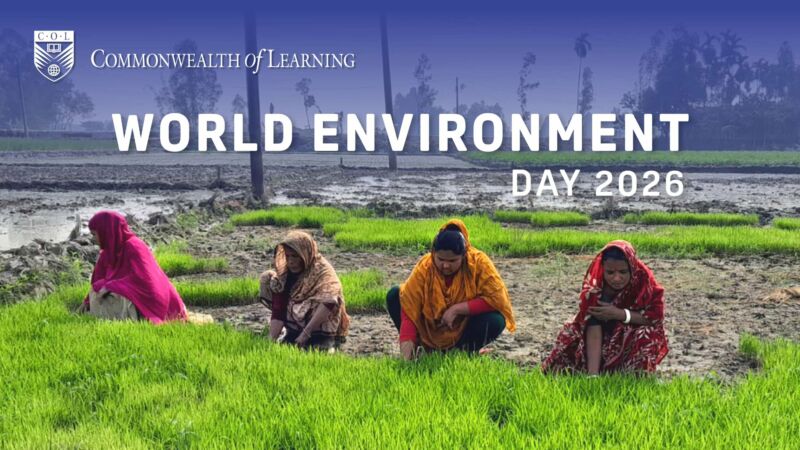
Millennium Goal Seven addresses the question of environmental sustainability directly. Here COL is helping institutions in India to develop a whole range of specialised courses in ODL format. These address directly some of the crucial issues for environmental sustainability, such as municipal water and waste management and solid waste management. These programmes will be made available to other developing countries.
Global Partnership
Finally, the eighth Millennium Goal calls for a global partnership to improve governance, to make the benefits of ICTs more widely availability and to give particular attention to the needs of landlocked and small island developing states. Such states are particularly vulnerable to natural calamities, as we have seen in the recent spate of hurricanes raging through the Caribbean, and they usually have a very narrow economic base.
Here again, COL's aim is to use technology to take learning to scale, whether it be the training of the hundreds of thousands of people now being asked to play a role in local democratic councils in India, or the difficult challenge of equipping disaffected male school dropouts in the Caribbean with usable life skills and occupational skills.
Conclusion
I hope this rather different approach to bridging divides by building capacity for post compulsory education through cross-border provision has expanded your understanding of the educational imperatives of our divided but interconnected world. COL starts from the premise that the use of human reason, and the knowledge that flows from it, is the key to enabling all people to enjoy healthy and decent lives. As a world leader in the new field of knowledge management COL has a special mission to help people access knowledge that they can use.
Development depends on the creation, dissemination and application of knowledge by everyone. Technology can greatly facilitate these processes. Some of the methods of cross-border education can be used to help billions of poor people achieve better lives.